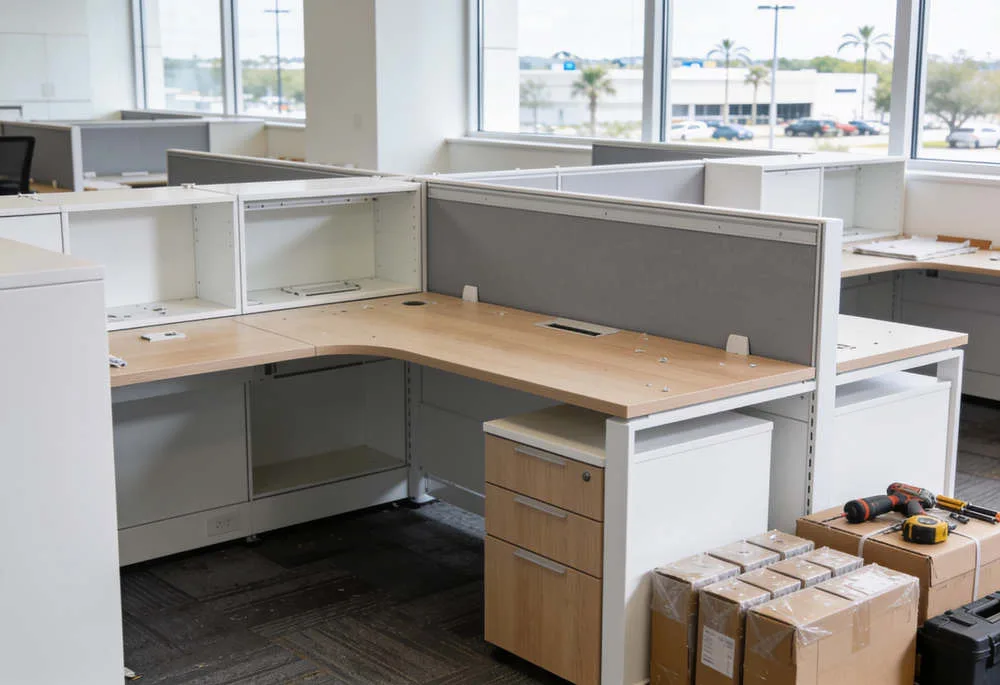
For Orlando facility managers comparing the cost to reconfigure office cubicles vs buy new furniture, reconfiguration is usually the more economical and faster option when existing modular systems are still serviceable. Near Downtown Orlando, where companies may need to adapt quickly to staffing changes or lease decisions, reusing what already works can protect both budget and schedule.
A workspace near Lake Nona may need fewer assigned desks, more team areas, or a different departmental layout without requiring an entirely new furniture package. 360 Modular Furniture Installations helps commercial clients assess what can stay, what should move, and what needs to leave the space. To discuss an upcoming reset, contact 360 Modular Furniture Installations at (407) 286-1030 and review the scope before crews start moving panels or workstations.
The same calculation matters around the Central Florida Research Park, where growing teams and technology companies may need offices that change without lengthy construction. Modular furniture gives facility managers options that traditional hard-walls simply do not.
Reconfiguration starts with the furniture you already own
Buying new furniture can look like the cleanest solution on paper. In practice, it brings procurement lead times, delivery coordination, removal decisions, and a larger capital expense. If existing cubicles and modular components remain functional, reconfiguring them can avoid much of that cost.
The first step is a practical inventory. Which workstations still serve the team? Which panels can be reused in a new layout? What should be decommissioned, stored, or liquidated? Answering those questions early keeps the project from turning into a last-minute scramble.
This is where professional office furniture installation matters. Experienced installers can disassemble, move, reconfigure, and reinstall modular systems while reducing the risk of damaged components, unsafe setups, and unnecessary downtime.
Hard-walls lock in a layout, modular systems leave room to change
Traditional hard-wall offices are rigid by design. Moving a wall can involve construction, permits, electrical work, dust, noise, and disruption. A modular workstation system works differently. Teams can grow, shrink, relocate, or change how they collaborate without rebuilding the office around every staffing decision.
That flexibility has direct financial value. A company that adds ten employees may be able to rework its current footprint instead of purchasing a full new furniture package. If a department downsizes, usable components can be reassigned elsewhere rather than discarded.
The real ROI includes time and downtime
Furniture cost is only one line in the calculation. Facility managers also have to consider how long the office will be disrupted and whether employees can work safely during the transition.
A poorly planned reconfiguration can create bottlenecks fast. Parts go missing. Panels get damaged. Workstations are assembled in the wrong sequence, and employees arrive to find that their desks are not ready. Professional installation reduces those risks by sequencing the work around the approved layout and project schedule.
For many Orlando businesses, speed matters most during a lease turnover or a January workspace reset. Those windows often come with firm deadlines. The old tenant is leaving, a new team is arriving, or leadership wants the floor ready before normal operations resume.
Define the scope before comparing costs
A useful cost comparison should separate the project into clear decisions rather than treating the entire office as one furniture problem. Facility managers should identify:
- Furniture and workstations that stay exactly where they are.
- Modular components that will be reconfigured or moved.
- Items that should be decommissioned, removed, stored, or liquidated.
- New pieces needed only where the existing inventory cannot support the new plan.
That scope makes the comparison more realistic. Reusing 70 percent of an existing modular system and purchasing only what is missing can be far more cost effective than replacing every workstation for the sake of uniformity.
When buying new furniture does make sense
Reconfiguration is not always the right answer. Existing furniture may be badly damaged, incompatible with the new layout, or insufficient for the number of employees. A major brand change may also justify replacement.
The point is to make that decision from an inventory and layout review, not from the assumption that every office change requires all-new furniture. Sometimes replacement is necessary. Often, it is not.
Orlando offices need layouts that can keep changing
Orlando's commercial market includes healthcare operations, technology companies, professional services, and businesses moving between leased spaces. Their headcounts and space requirements do not stay fixed forever.
A modular office can respond to those changes without forcing the facility team to start over each time. Reconfiguration preserves useful assets, shortens the path to a functioning workspace, and gives managers more control over future moves.
Plan your Orlando office reconfiguration
If you are weighing the cost to reconfigure office cubicles vs buy new furniture in Orlando, call (407) 286-1030 or reach out to 360 Modular Furniture Installations to review your existing furniture, project scope, and installation timeline.