Clearing out a commercial office space in Orlando, Florida is one of the most logistically demanding projects a facility manager will face. Between tight lease deadlines, disposal regulations, and the sheer volume of assets to sort through, the process can spiral quickly without a clear plan. Whether you're vacating a Downtown Orlando high-rise or shutting down a Dr. Phillips corporate campus, getting your liquidation strategy right from day one will save you thousands of dollars and weeks of headaches.
If you need experienced hands on your next decommission, call 360 Modular Furniture Installations at (407) 286-1030 to schedule a consultation.
How Do You Know Which Office Furniture Is Worth Liquidating vs. Disposing?
Not every chair, desk, or workstation deserves the same treatment. High-quality commercial furniture from brands like Herman Miller, Steelcase, and Haworth can retain 30–60% of its original value when resold through the right channels, while low-grade particleboard pieces typically fetch nothing and cost you money to haul away.
Start your evaluation with a physical condition assessment. Look for structural integrity, fabric wear, and finish damage. A six-year-old Steelcase task chair in good condition can sell for $150–$300 on the secondary market. A generic big-box store chair of the same age? Budget $50–$80 per unit just for removal and disposal.
The key criteria to assess during your walkthrough:
- Age: Pieces under 10 years old from name brands hold value best
- Brand and grade: Contract-grade commercial furniture outperforms consumer-grade in resale
- Condition: Surface scratches are acceptable; broken mechanisms or stained fabric are not
- Quantity: Buyers prefer matched sets — 40 identical workstations will move faster than 40 mismatched ones
Once you've sorted your inventory into "liquidation-eligible" and "dispose" categories, you're ready to price and market the sellable assets. Our team at 360 Modular Furniture Installations has completed hundreds of office furniture installation and decommissioning projects across Central Florida. In our experience, facility managers who skip this evaluation step leave $5,000–$20,000 in recoverable asset value on the table.
What Are the Most Sustainable Ways to Decommission Commercial Furniture in Florida?
Florida businesses face growing pressure to reduce landfill contributions, and Orange County has become increasingly strict about commercial waste disposal standards. The good news: sustainable disposal and cost recovery aren't mutually exclusive.
Here's how responsible decommissioning works in practice:
Donate first. Nonprofits, schools, and community organizations throughout Central Florida — including groups serving the Parramore neighborhood and Pine Hills corridor — actively accept usable office furniture. Donating qualifies as a tax-deductible contribution, and many organizations will coordinate pickup at no cost to you.
Resell through liquidators. Secondary market buyers and auction platforms move large furniture lots quickly. Expect the process to take 2–4 weeks from listing to pickup for large-scale lots.
Recycle metals and components. Cubicle frames, filing cabinets, and steel pedestals have strong scrap value. Aluminum and steel components typically yield $0.10–$0.30 per pound at Central Florida recycling facilities.
Partner with zero-landfill vendors. Some decommissioning partners — including operations like ours — maintain strict protocols to keep usable materials out of the waste stream entirely. Every item that doesn't sell gets redirected to donation, deconstruction for parts, or certified recycling. Nothing goes to a landfill by default.
This approach matters because Florida's commercial landfill tipping fees have climbed to $40–$60 per ton in Orange County. A 10,000-square-foot office space with standard furnishings can generate 8–15 tons of material. Do the math: unmanaged disposal can cost $400–$900 in tipping fees alone, before you even factor in labor and hauling.
Navigating Florida Regulations and Local Logistics
Commercial furniture liquidation in Orlando, Florida carries specific logistical considerations that out-of-state vendors routinely underestimate.
Orange County requires commercial waste haulers to carry proper licensing under Florida Statute 403.7046. Any vendor you hire for bulk removal must comply. Verify their certificate before signing a contract — non-compliant haulers can expose your organization to fines up to $10,000 per violation.
Building access is another pressure point, especially in Downtown Orlando's high-density office corridors near South Orange Avenue and in the fast-growing Lake Nona Medical City area. Loading dock scheduling, elevator reservations, and after-hours access agreements all need to be locked in 2–3 weeks before your first asset-removal day. Miss that window and you're looking at delays that can trigger holdover rent penalties — typically 125–150% of your base monthly rate.
Municipal bulk waste ordinances also vary by district. What's permissible at a Dr. Phillips business park may require additional permitting near a mixed-use development in Thornton Park. A local liquidation partner who works these markets regularly will already know the rules.
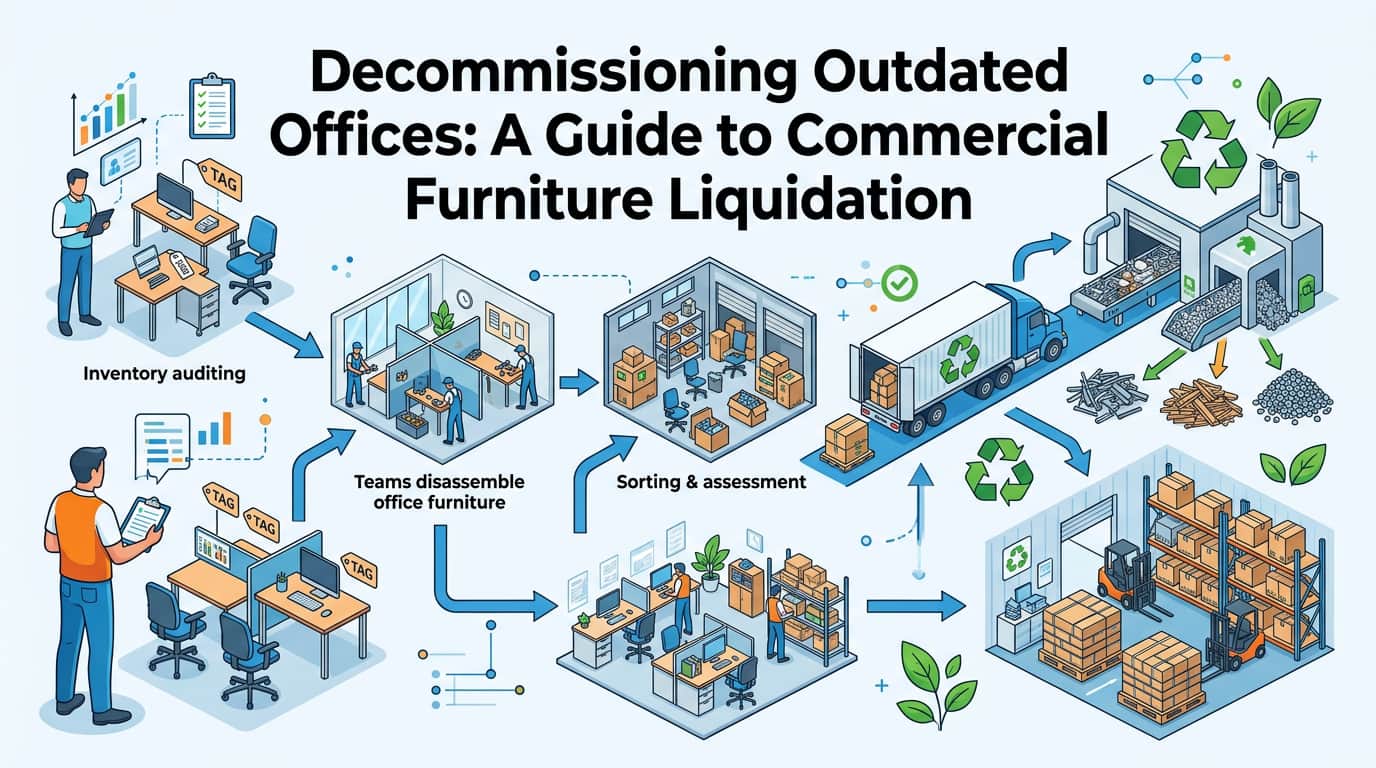
The Liquidation Process: A Step-by-Step Checklist
Use this checklist to keep your decommission on track from start to final broom-sweep:
Step 1: Initial Inventory (6–8 weeks before vacate date)
Walk every square foot of the space. Document each asset by category, brand, age, and condition. Photograph everything. Create a spreadsheet with quantity counts by furniture type.
Step 2: Asset Valuation (5–6 weeks out)
Sort inventory into three groups: high-value resale, donation-eligible, and disposal. Get at least two quotes from liquidators on your sellable assets.
Step 3: Buyer and Donation Outreach (4–5 weeks out)
List high-value lots with secondary market buyers. Contact local nonprofits and schools for donation pickups. Confirm pickup dates in writing.
Step 4: Logistics Coordination (3–4 weeks out)
Book loading docks, elevators, and freight access. Confirm building management rules for removal days. Arrange haul-away for disposal items separately from sellable assets.
Step 5: Disassembly and Removal (1–2 weeks out)
Begin disassembly with qualified crews who know how to deconstruct panel systems, modular walls, and workstations without damaging adjacent finishes or flooring. This protects your security deposit.
Step 6: Final Site Broom-Sweep (vacate day)
Confirm the space is clear, clean, and in lease-compliant condition. Walk the space with building management for sign-off. Retain documentation of all donation receipts and disposal manifests for your records.
Rushing any step in this sequence creates cascading problems. We've seen facility managers in the Lake Nona and Sand Lake corridors lose $3,000–$7,500 in security deposits because furniture removal damaged flooring or walls during a hurried exit. Proper disassembly planning prevents that.
Ready to Start Your Office Decommission?
Office decommissioning doesn't have to be the chaotic, expensive ordeal most facility managers dread. With the right inventory process, a zero-landfill disposal strategy, and a local team that knows Florida's regulations and logistics, you can recover capital, meet your lease deadline, and hand back a clean space.
360 Modular Furniture Installations has over 20 years of experience handling commercial furniture projects across Orlando and Central Florida. Our certified installation and removal crews manage projects of every scale, from single-floor offices to multi-building campus decommissions. We handle the logistics, protect the space, and keep as much material as possible out of the waste stream.
Call us today at (407) 286-1030 to talk through your project timeline and get a free quote.