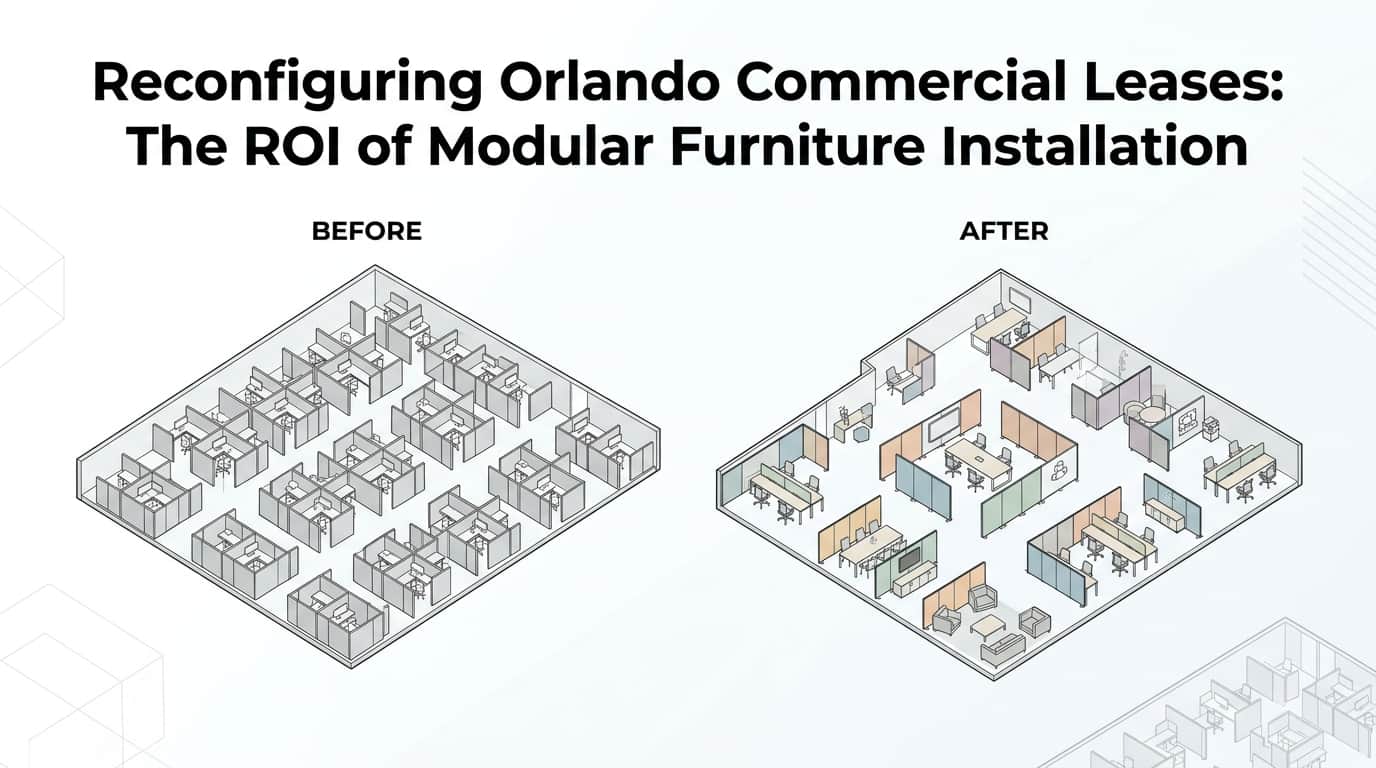
Hard-wall construction on a new commercial lease in Orlando can run $50–$150 per square foot. That's before you account for permitting delays, contractor schedules, and the weeks of downtime that come with a traditional build-out. 360 Modular Furniture Installations helps facility managers skip all of that. Call us at (407) 286-1030 to get a free quote on your next project.
The commercial real estate picture across Central Florida has shifted fast. Companies along the Lake Nona Medical City corridor and throughout the Dr. Phillips business district are signing leases in newly built Class A spaces, then facing the same old problem: how do you configure a raw floor plate quickly, affordably, and in a way that actually supports how your team works? The answer, for a growing number of Orlando facility managers, is modular office furniture.
What Is Modular Office Furniture, and Why Are Orlando Businesses Switching?
Modular office furniture refers to pre-engineered, reconfigurable components that assemble without permanent construction. Think panel systems, benching units, stackable storage, and freestanding partitions that connect, disconnect, and rearrange as your headcount or workflow changes.
Unlike fixed drywall offices, modular components aren't attached to the building. That distinction matters more than most tenants realize. Hard-wall construction becomes a leasehold improvement, which means you may be responsible for restoring the space to its original condition when your lease ends. Modular furniture sidesteps that obligation entirely.
In our 20+ years handling office furniture installation across Central Florida, the teams we work with consistently cite two priorities: speed to occupancy and capital preservation. Modular systems deliver on both.
How Much Can You Actually Save by Avoiding Hard-Wall Construction?
Skipping a traditional build-out on a 5,000-square-foot office can save between $250,000 and $750,000 in construction costs alone. That's not a best-case estimate. It's the realistic range facility managers see when they compare contractor bids against a full modular furniture installation in Orlando, Florida.
Here's where the savings come from:
No permits for non-structural work. Modular panel systems and freestanding furniture typically don't require Orange County building permits the way drywall construction does. Permit timelines in Central Florida can run 4–12 weeks. Skip the permit, skip the wait.
Faster move-in. A skilled installation crew can complete a 10,000-square-foot modular office layout in 3–5 days. A comparable hard-wall build-out takes 6–12 weeks, sometimes longer if there are inspection backlogs.
No demolition costs at lease end. Restoring a built-out office to its original condition can cost $15–$30 per square foot. With modular furniture, you reconfigure or relocate instead of demolish.
For facility managers managing multiple locations or short-term leases, the math is straightforward.
Does Modular Furniture Qualify for Section 179 Tax Deductions?
Yes. Office furniture qualifies as personal property under IRS Section 179, which means your organization can deduct the full purchase price in the year the equipment is placed in service, rather than depreciating it over 7 years.
For 2024, the Section 179 deduction limit sits at $1,160,000. A $200,000 modular furniture installation could generate a deduction that saves a business in the 21% corporate tax bracket roughly $42,000 in the same tax year. Hard-wall construction, by contrast, is typically classified as a leasehold improvement and must be depreciated over 15 years under standard accounting rules. That's a meaningful difference in how quickly you recover your capital.
Always confirm specifics with your CPA, but this tax treatment is one reason CFOs tend to support the modular approach when facility managers present it.
How Do Modular Layouts Support Rapid Scaling in Orlando's Growth Corridors?
Orlando's economy has grown faster than most mid-sized metros over the past decade. The tech firms clustered around the University of Central Florida Research Park and the healthcare organizations expanding near Lake Nona don't have the luxury of long interior construction timelines. They're hiring quickly and need space that keeps pace.
Modular furniture installation in Orlando, Florida directly solves that problem. When a company grows from 40 to 70 employees in a single quarter, a panel-based workstation system can be expanded by adding components to existing runs. No contractors, no dust, no permits. The reconfiguration typically takes a crew one to two days.
The same flexibility works in reverse. If a department shrinks or shifts to a hybrid schedule, panels and benching can be removed and stored or redistributed. That kind of adaptability is essentially impossible with fixed construction without significant cost.
Does Office Furniture Design Affect Employee Productivity and Retention?
Research from the World Green Building Council found that well-designed workplaces improve productivity by up to 16%. That number gets cited a lot, but what it really points to is the cost of getting workspace design wrong.
Ergonomics matter. Adjustable-height surfaces, proper monitor positioning, and acoustic panel placement affect how long employees can focus before fatigue sets in. In Central Florida, where recruiting competition is real and turnover is expensive, the quality of your physical workspace is part of your employment value proposition.
Modular systems give facility managers the flexibility to reconfigure layouts based on how people actually work, rather than being locked into a floor plan that made sense at move-in but doesn't anymore. Collaborative zones, quiet focus areas, and hybrid-ready hot-desking setups can all be built with the same modular components. You're not ordering custom millwork every time the business changes.
What's the Environmental Case for Modular Office Components?
Standard hard-wall construction produces significant waste: drywall scraps, framing materials, packaging, and eventually the debris from demolition. Modular furniture produces a fraction of that waste during installation, and the components themselves can be reused indefinitely.
Most commercial-grade panel systems are designed to last 20–30 years with normal use. They can be disassembled, cleaned, reconfigured, and reinstalled in a different location. That resale value is real. Used Steelcase, Herman Miller, and Haworth panel systems regularly sell on the secondary market for 30–50% of their original cost, whereas demolished drywall has zero recovery value.
For organizations with sustainability reporting requirements or ESG commitments, the modular approach supports those goals in a concrete, documentable way.
Ready to Reconfigure Your Orlando Commercial Space?
The right office layout doesn't require a construction crew, a permit, or six weeks of downtime. A well-planned modular furniture installation in Orlando, Florida protects your capital, accelerates your occupancy timeline, and gives you a workspace that can change as fast as your business does.
360 Modular Furniture Installations has been helping Central Florida businesses configure productive, professional spaces for over 20 years. Our field supervisors walk every site before a project starts, coordinate directly with your team, and manage the installation from delivery through completion.
Call us at (407) 286-1030 or visit us online to request a free quote. We'll help you get the right layout in place without the construction headaches.